 It’s not uncommon for companies to question the business case behind using social media. ‘What’s the Return on Investment (ROI)?’ management ask. The fact of the matter is that we are social beings by nature and this brave new world of social media is a digital extension of the way we operate in real life.
A friend of mine recently told me that if he was to walk into a particular upmarket hotel in Hong Kong tomorrow the concierge and staff would greet like a long lost friend and ask after his wife and family, despite him never spending a night there. It’s not that they are particularly over friendly in this hotel, this happens because my friend is what is known as a familiar stranger.
This is one of several examples of social psychology that offers another way of thinking about the business case for using social media more regularly:
The Familiar Stranger
We all have them in our lives, people that we recognise from regular activities, but with whom we do not interact. They are visual rather than verbal relationships where both parties maintain anonymity. Particularly common in urban environments, a good example of a familiar stranger would be someone you see on your regular commute to work, but never speak with. In the case of my friend, the staff in the hotel felt close to him because they had seen him around the lobby and the bar on a regular basis. As a policeman and security specialist he has used this technique to infiltrate secure buildings.
If you exist on social media you are opening yourself up to a larger number of familiar strangers to become aware of you and what you do. You will be surprised at the number of people who watch and listen on these networks and become interested in you as you go about your business online, even though they never engage directly with you. Becoming a digital familiar stranger can also help you bypass gatekeepers to get to those all important sales contacts.
The Power of Crowds
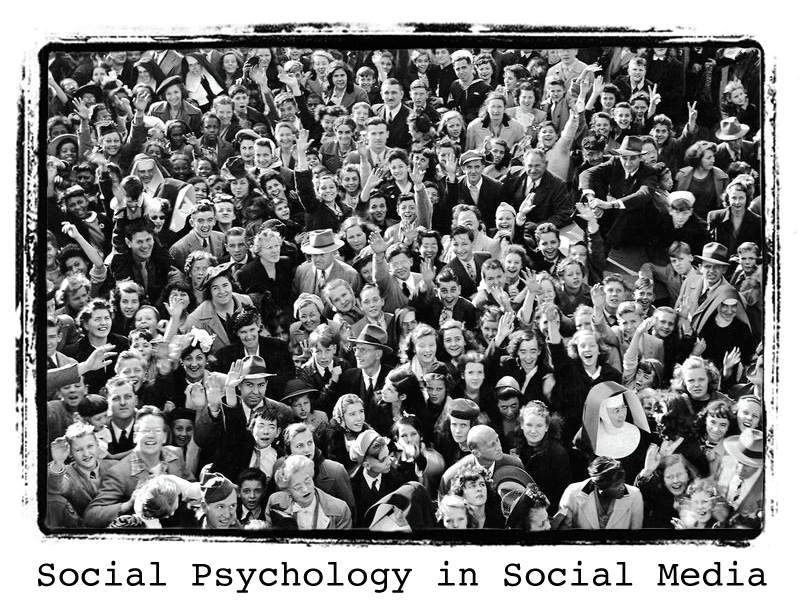
Have you ever joined a crowd without knowing why? One social psychology study arranged for collaborators to stand together and stare up at a film camera on the sixth floor window above a busy city street. Only 4% of passers by stopped and looked up a single person was standing there doing this same, whereas 40% stopped if 15 people were already there gazing upwards. The crowd had a contagious effect on behaviour. Modern studies show variances on how this works today.
What I find most interesting about this experiment is the small number of collaborators you need to attract a bigger crowd. You might only need fifteen people staring up at your blog and engaging with your Facebook pages for more passing people to be drawn to your business to see what everyone else is looking at.
It’s a Small World
Many believe that we are all connected to one another by six degrees of separation. In other words you could start with a farmer in Outer Mongolia who would know someone, who knows someone, who knows someone, who knows someone, who knows someone who knows US President Obama. This idea has been popularised by the Six Degrees of Kevin Bacon game.
We are probably all more closely connected to the people we wish to connect with than we think. That important buyer, that key supplier or that particular customer we are hoping to connect with is just a hop, skip and a jump away on social media. LinkedIn in particular tracks how our networks are connected.
Weaker Links
The people we love and feel the most connected to us are often the ones we value the most in our lives. Yet studies have shown that it is actually the weaker links in our networks of relationships that can be the most valuable to us when landing better jobs. In other words it’s not always our close friends that help us with our careers, but our peripheral acquaintances.
Having a wide range of relationships and connections is possible on the variety of social media tools we have for managing our relationships. If you are not using these tools you are missing out on developing these relationships and the opportunities that come with them.
We all know elements of these social psychology experiments to be true having seen aspects of them in our everyday lives. Yet many people and businesses put off joining social media networks or engaging on them because they are so focussed on direct returns rather than seeing the bigger picture of going well in the digital world and convincing by our digital presence.